Dubai Airports dealt with 111 threat alerts and 17 ballistic missile strikes during the regional conflict this year, highlighting the resilience of Dubai’s aviation sector during one of its most challenging periods, CEO Paul Griffiths said on Thursday.
Speaking at an international media briefing hosted by the Dubai Media Office, Griffiths said the airport operator successfully managed the unprecedented disruption while maintaining the safety of passengers and employees.
“The most satisfying statistics: there were zero deaths and very, very limited casualties. I’m very pleased to say that all of those people have now fully recovered,” Griffiths said.
The comments come as Dubai’s aviation industry continues to recover from the disruption caused by the wider regional conflict.
Limited injuries reported
According to Griffiths, most of the injuries recorded during the threat alerts were minor. Many occurred as passengers and employees rushed toward designated shelters when warnings were issued.
“Most of them were just falling over each other in the early stages when they actually were running too quickly to get to shelter,” Griffiths said, adding that airport authorities subsequently managed to calm the situation and maintain better control.
Dubai International Airport, one of the world’s busiest international aviation hubs, was also affected by the wider security situation after Iran targeted several Gulf countries with drones and missiles following US-Israeli attacks on Iran.
The airport itself was targeted by Iranian drones during the conflict, adding to the security challenges faced by Dubai Airports.
Despite the attacks and repeated alerts, Griffiths said the overall response demonstrated the strength of the UAE’s security infrastructure and crisis-management systems.
Griffiths praises UAE government response
Griffiths credited the UAE government’s communication during the crisis as an important factor in helping Dubai Airports respond quickly.
He said clear communication enabled airport officials to take measures designed to protect passengers and employees as threats emerged.
The Dubai Airports CEO also praised the UAE’s air-defence systems and their ability to intercept incoming threats.
“I don’t think any of us felt anything but safe and secure throughout the crisis,” Griffiths said.
Griffiths pointed to Dubai’s previous experience in managing major crises, including the global financial crisis and the Covid-19 pandemic, as evidence of the city’s ability to recover from significant disruptions.
He has led the organisation for nearly two decades and said the latest crisis provided another example of Dubai’s ability to respond to major shocks and quickly restore normal operations.
Passenger traffic rebounds sharply
While the conflict caused a significant decline in passenger traffic, Dubai Airports has experienced a strong recovery in the months since the disruption.
Passenger numbers fell to about 2.5 million in March before rising to approximately 5 million in June. Traffic increased further to 6.3 million passengers in July, representing a 26% month-on-month increase.
The rapid recovery has strengthened expectations that Dubai International Airport can return toward its long-term passenger growth targets.
Dubai Airports handled 31.5 million guests during the first half of 2026, according to Griffiths. The airport operator is now projecting approximately 70 million guests for the full year.
That figure would still be below the record levels seen before the latest disruption. Dubai International Airport closed 2025 with 95.2 million guests.
However, Griffiths said the airport remains confident about eventually returning toward the “magic” 100 million passenger milestone that Dubai has targeted for years.
Recovery described as a “trampoline bounce”
Griffiths used an unusual analogy to describe the airport’s recovery, saying the rebound was more like a “trampoline bounce” than a “dead cat bounce.”
“We go down, we hit the trampoline, and then we bounced even higher than before,” he said.
The comparison reflects the speed with which passenger traffic recovered after the sharp decline during the conflict.
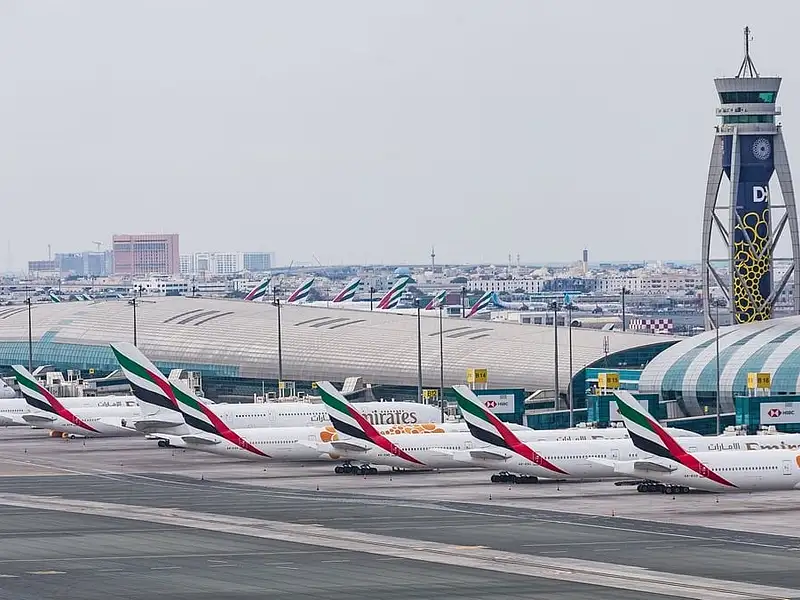
For Dubai Airports, the recovery is particularly significant because Dubai International Airport plays a central role in the emirate’s tourism, business and international connectivity.
The airport serves as a major global hub, connecting travellers between Europe, Asia, Africa, the Middle East and other regions.
Aviation sector demonstrates resilience
The experience has also highlighted the importance of crisis preparedness for major international airports operating in regions affected by geopolitical tensions.
Dubai Airports had to respond to repeated threat alerts while maintaining essential operations and protecting passengers and staff.
The reported 111 threat alerts and 17 missile strikes demonstrate the scale of the security challenge faced by the airport during the conflict. Nevertheless, the absence of fatalities and the recovery of those who suffered minor injuries underline the effectiveness of the emergency response.
The UAE government’s communication, airport security measures and air-defence capabilities were all cited by Griffiths as important elements of the response.
With passenger numbers recovering rapidly, Dubai Airports is now focused on restoring traffic levels and maintaining Dubai International Airport’s position as a leading global aviation hub.
The projected 70 million passengers for 2026 would represent a significant recovery from the disruption earlier in the year, although it would remain below the 95.2 million passengers recorded in 2025.
Griffiths’ comments suggest that Dubai Airports expects the recovery to continue, with the longer-term ambition of once again approaching the 100 million passenger threshold.
For Dubai’s aviation industry, the latest figures offer a positive signal following months of unprecedented regional uncertainty. The airport’s ability to maintain safety during repeated threats while rapidly rebuilding passenger traffic demonstrates the resilience that has helped establish Dubai as one of the world’s most important aviation centres.
Post Views: 15