

Bayut’s H1 2026 Dubai Sales Market Report highlights the growing diversity of demand across the emirate’s off-plan residential market, with buyers exploring projects across a remarkably wide range of prices, communities and property types.
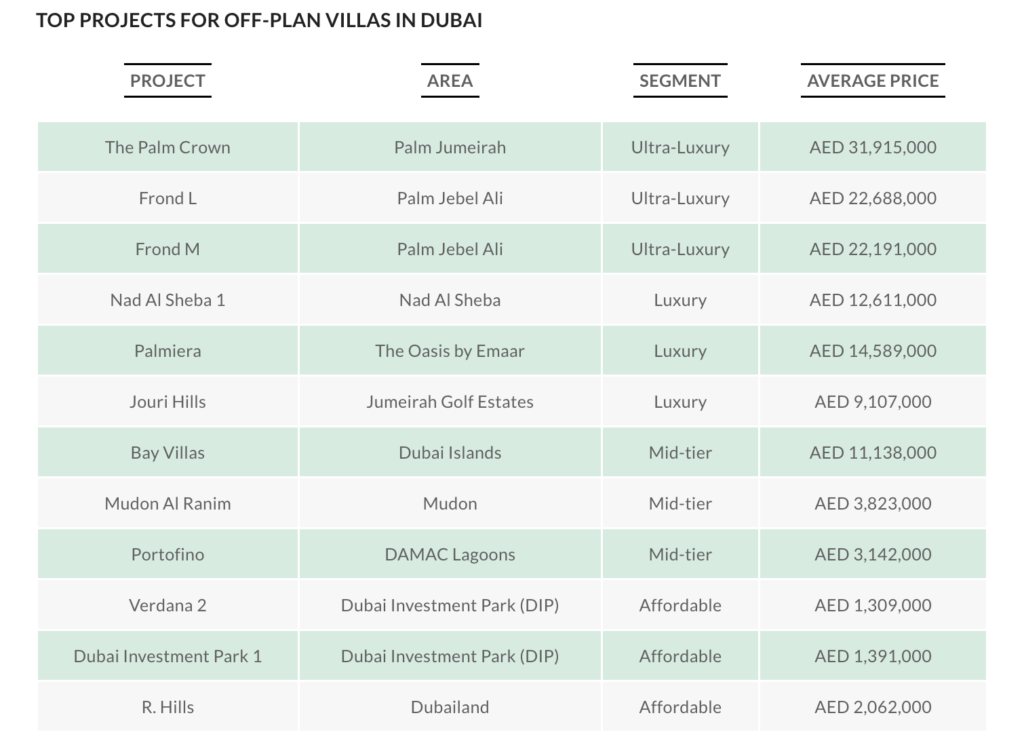
From apartments priced at just over AED 600,000 to luxury residences approaching AED 12 million, and villas ranging from around AED 1.31 million to more than AED 31 million, the data points to a market that is serving buyers with very different budgets and investment objectives.
Dubai Off-Plan Market Spans a Wide Price Range
The Dubai off-plan market has developed into one of the most diverse segments of the emirate’s residential property sector. Bayut’s H1 2026 data shows that demand is spread across affordable, mid-tier, luxury and ultra-luxury developments.
In the affordable apartment segment, Dubai Investment Park 1 recorded average prices of just over AED 600,000 for popular off-plan projects. This relatively accessible entry point continues to make Dubai’s emerging communities attractive to buyers seeking new properties without entering the higher price brackets of established luxury areas.
At the opposite end of the spectrum, The Crescent on Palm Jumeirah recorded average prices approaching AED 12 million, demonstrating the significant premium attached to prime waterfront locations and high-end residential developments.
The villa segment shows an even broader price range. Verdana 2 in Dubai Investment Park recorded an average price of approximately AED 1.31 million, while The Palm Crown on Palm Jumeirah reached an average of AED 31.92 million.
This substantial difference illustrates how the Dubai off-plan market caters to both first-time and budget-conscious buyers as well as high-net-worth individuals seeking exclusive residences.
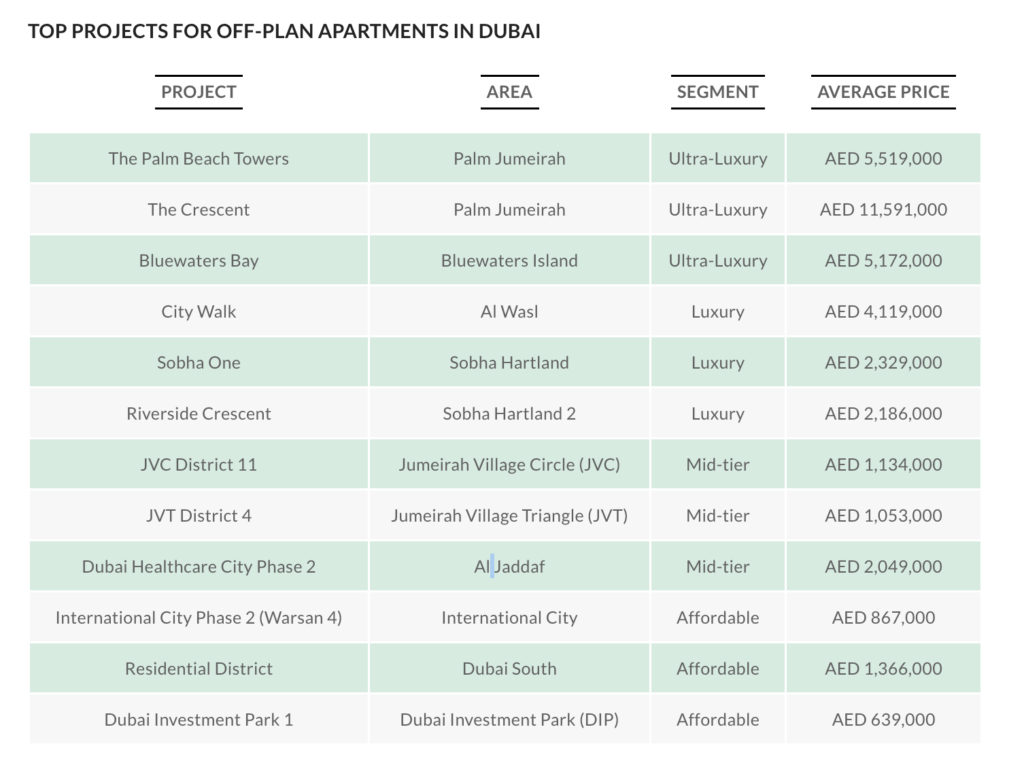
Popular Off-Plan Projects Across Dubai
Buyer interest is also distributed across several distinct communities and price categories.
In the ultra-luxury apartment segment, The Palm Beach Towers, The Crescent and Bluewaters Bay were among the projects attracting strong buyer attention. These developments benefit from premium locations, lifestyle offerings and proximity to some of Dubai’s most established attractions and waterfront destinations.
Within the luxury segment, City Walk, Sobha One and Riverside Crescent stood out among the preferred off-plan projects.
The mid-tier segment included JVC District 11, JVT District 4 and Dubai Healthcare City Phase 2. These communities offer buyers a combination of residential amenities, connectivity and comparatively accessible pricing compared with Dubai’s most expensive prime locations.
For buyers looking for more affordable opportunities, International City Phase 2, Residential District in Dubai South and Dubai Investment Park 1 featured among the popular choices.
The spread of these projects demonstrates that demand is not concentrated in a single part of Dubai. Instead, buyers are evaluating developments based on different combinations of affordability, location, infrastructure, lifestyle and future potential.
What Is Driving Off-Plan Property Demand?
Several factors are contributing to the continued appeal of the Dubai off-plan market.
Flexible payment plans remain an important consideration, particularly for buyers who want to spread their property payments over the construction period. Lower initial entry requirements can also make off-plan purchases more accessible compared with some ready properties.
However, buyer priorities appear to be moving beyond payment flexibility alone.
Location is increasingly important as buyers assess access to major roads, public transport, employment centres, schools, retail destinations and leisure facilities. The infrastructure surrounding a development can have a significant influence on its long-term attractiveness.
Community planning is another consideration. Buyers are increasingly interested in what a neighbourhood will look like once development is completed, including amenities, green spaces, retail options and connectivity.
Developer reputation is also becoming an important part of the decision-making process.
Akash Kanjwani, Founder and Group Chief Executive Officer of Sky View Real Estate and Sky View Developments, said that off-plan property continues to attract buyers because it provides flexibility, choice and access to new communities. However, he noted that buyers are becoming more informed and are asking more detailed questions about developers, locations, surrounding infrastructure and the future character of communities.
According to Kanjwani, payment plans may initially attract buyers, but the underlying fundamentals of a project are increasingly influencing the final purchase decision.
Buyers Are Becoming More Selective
The H1 2026 data suggests that Dubai’s off-plan buyers are becoming more deliberate when comparing projects.
Rather than simply choosing between an off-plan and a ready property, buyers are increasingly comparing individual developments against one another. Factors such as location, pricing, amenities, connectivity, rental prospects and future value are all becoming part of the decision-making process.
This shift could be particularly important as the number of residential developments across Dubai continues to expand.
With more projects available at different price points, buyers have greater choice. This means developers must increasingly differentiate their projects through location, design, amenities, community planning, payment structures and overall value.
Fibha Ahmed, VP of Property Sales at Bayut, said the company’s H1 2026 data shows that Dubai’s off-plan market is attracting a remarkably diverse range of buyers.
She highlighted that motivations are becoming increasingly specific, with buyers comparing projects on factors including price, location, lifestyle, connectivity, rental potential and future value.
The breadth of communities attracting buyer interest reflects the depth of Dubai’s off-plan sector and indicates that buyers are becoming more informed about how they evaluate property opportunities.
Location and Connectivity Remain Key Considerations
Dubai’s continued expansion is creating new residential communities while strengthening connections between established and emerging areas.
For off-plan buyers, this creates an opportunity to enter communities before they reach full maturity. However, it also makes research increasingly important.
Buyers are looking beyond the property itself and considering how the surrounding area may develop over the coming years. Roads, public transport, commercial centres, schools, healthcare facilities and leisure destinations can all influence the attractiveness of a residential project.
This is particularly relevant for investors who are considering future rental demand. A property located within a growing community with improving infrastructure may appeal to tenants seeking accessibility and modern amenities.
At the same time, owner-occupiers may place greater emphasis on lifestyle facilities, community design and proximity to everyday services.
Affordable and Luxury Segments Continue to Coexist
One of the clearest characteristics of Dubai’s off-plan market is the coexistence of very different buyer segments.
At one end, buyers can explore apartments in communities such as Dubai Investment Park 1 and International City Phase 2, where comparatively lower prices provide an entry point into Dubai’s property market.
At the other end, ultra-luxury developments on Palm Jumeirah and other prime waterfront locations attract buyers willing to spend millions of dirhams on high-end apartments and villas.
This broad spectrum means that Dubai’s off-plan sector cannot be defined by a single buyer profile.
Some buyers may be focused on affordability and payment flexibility, while others may prioritise exclusivity, waterfront living, lifestyle amenities or long-term capital appreciation.
Outlook for Dubai’s Off-Plan Market
The diversity highlighted by Bayut’s H1 2026 data suggests that off-plan property will continue to play an important role in Dubai’s residential market.
As buyers become more knowledgeable, the emphasis is likely to remain on the complete value proposition of individual projects rather than price alone.
Developers with strong reputations, attractive locations, reliable infrastructure plans, competitive payment structures and well-designed communities may remain well positioned to capture demand.
For buyers, the expanding range of options provides greater choice but also increases the importance of due diligence. Understanding the developer, location, project fundamentals, expected infrastructure, payment schedule and potential future demand can help buyers make more informed decisions.
Overall, the H1 2026 figures underline the depth and diversity of Dubai’s off-plan property sector. From apartments costing slightly above AED 600,000 to villas exceeding AED 30 million, the market is attracting buyers across almost every price category.
The key difference is that buyers are becoming increasingly selective. While affordability and payment flexibility remain relevant, location, connectivity, lifestyle, developer credibility, rental potential and long-term value are playing a growing role in determining which projects ultimately attract attention.

Manish Singh is the Editor-in-Chief of UAE Reporter and Founder of Credible Media LLC, a UAE-based media and public relations company. He began his career in music marketing at 16 before expanding into digital publishing and editorial storytelling. At UAE Reporter, he leads coverage of business, innovation, lifestyle and the people shaping the Emirates.
- IMF projects UAE economy to rebound 7.7% in 2027 after sharp 2026 contraction
- Dubai office sales jump 11.7% in Q3 as smaller investors return to the market
- Kamel Ghribi Brings Global Leaders Together to Shape a New Vision for Africa, Europe and the Middle East
- UAE DIGITAL ASSETS: BUILDING THE INFRASTRUCTURE FOR INSTITUTIONAL INVESTMENT