Dubai humanoid robots are set to become a potential part of a new technology partnership between a Dubai-based company and a Chinese manufacturer, following the signing of a five-year agreement that could provide capacity for up to 10,000 humanoid robots a year.
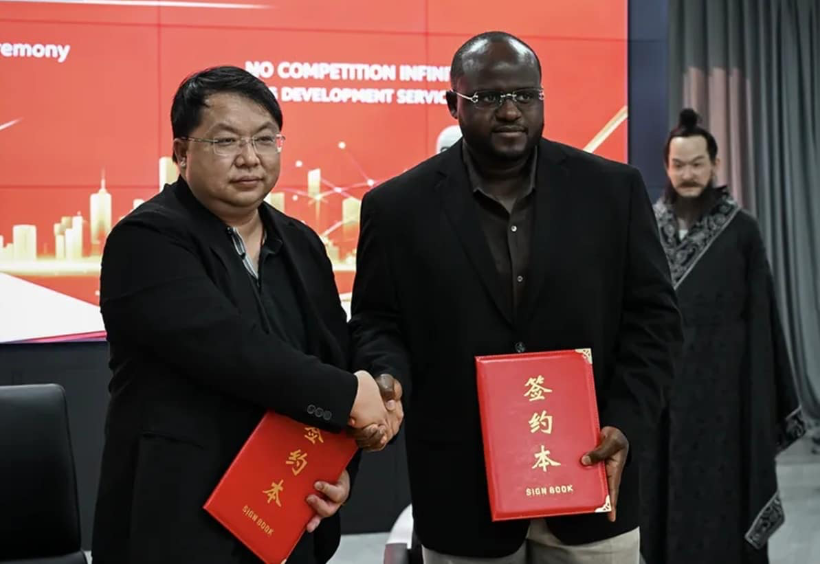
No Competition Infinity Gaming Development Services has signed the agreement with China’s Jiangsu Yunmu Intelligent Manufacturing Technology to develop and deploy solutions combining artificial intelligence, digital twins, advanced simulation and humanoid robotics.
The agreement was signed in Taicang, China, establishing a long-term technology partnership between the two companies.
Under the agreement, the companies will initially examine potential applications for humanoid robots and related technologies across several sectors, including construction, real estate development, gaming, education, technology research and training.
FIVE-YEAR AGREEMENT CREATES ROBOT SUPPLY CAPACITY
The agreement establishes contractual capacity for Jiangsu Yunmu Intelligent Manufacturing Technology to supply up to 10,000 humanoid robots per year during the five-year term.
However, the stated capacity does not necessarily mean that 10,000 robots will be manufactured or deployed every year.
The agreement allows the capacity to be adjusted depending on project progress, technical validation and the expansion of commercial applications.
This means deployment is expected to develop progressively as the companies validate technologies and identify practical use cases.
The partnership will therefore begin with technology development and assessment before potentially moving towards larger commercial applications.
AI, DIGITAL TWINS AND ROBOTICS COMBINE
The partnership brings together several technology areas rather than focusing solely on physical robots.
Jiangsu Yunmu Intelligent Manufacturing Technology contributes its humanoid robot development and manufacturing capabilities.
No Competition Infinity Gaming brings expertise in gaming, virtual environments, real estate and simulation.
The companies intend to combine artificial intelligence, digital twins and advanced simulation with humanoid robotics.
Digital twins can provide virtual representations of physical environments and processes, allowing companies to simulate activities before deploying technology in real-world settings.
For robotics, this approach can potentially provide an environment in which machines can be trained and tested before being introduced into live operations.
CONSTRUCTION AMONG INITIAL APPLICATIONS
Construction is one of the sectors being examined under the partnership.
The companies are studying how humanoid robots and related technologies could potentially be applied to construction and real estate development.
Construction sites can involve repetitive tasks, physically demanding activities and environments where workers may face safety risks.
The proposed technology strategy aims to explore whether robots could eventually assist with selected activities while humans remain involved in areas requiring judgement, supervision and specialist expertise.
However, the partnership is still at the stage of studying potential applications and validating technology.
No specific large-scale construction deployment has been announced as part of the agreement.
DIGITAL TWINS TO SUPPORT ROBOT TRAINING
A central element of the strategy is the use of virtual environments and digital twins.
No Competition plans to use these platforms to train and validate technology before it is deployed in physical environments.
Processes can first be recreated in a simulated environment.
Robotic systems can then be tested against different scenarios, with potential improvements made before physical deployment.
The approach could allow companies to identify technical problems earlier and refine robotic operations before introducing machines into real-world settings.
For construction and real estate, digital twins could potentially be used to model buildings, work sites and operational processes.
This could provide a controlled environment for evaluating how robotic systems interact with complex physical spaces.
PROGRESSIVE DEVELOPMENT MODEL
The partnership is expected to follow a progressive development model.
The first stage will focus on technology validation.
Once technologies demonstrate sufficient technical performance, the companies can move towards pilot projects.
Successful pilots could then provide a foundation for potential expansion into commercial-scale applications.
This staged approach allows the companies to gather information and evaluate the technology before committing to broader deployment.
It also provides an opportunity to identify limitations and determine where humanoid robots can provide practical value.
GAMING AND VIRTUAL ENVIRONMENTS
Gaming is another area of potential application.
No Competition Infinity Gaming is a Dubai-based company focused on the convergence of construction, digital gaming, virtual environments and robotics.
The company’s experience in gaming and simulation could contribute to the development of immersive environments where robotic systems can be trained and tested.
Gaming technologies can provide sophisticated virtual environments that simulate different physical scenarios.
Combining those capabilities with artificial intelligence and robotics could create platforms for training machines before they operate in real-world environments.
The partnership therefore extends beyond the manufacture of humanoid robots and focuses on developing an ecosystem around their deployment.
EDUCATION ALSO PART OF THE STRATEGY
Education is another potential application being studied by the companies.
Manuel Zau Polo, President of No Competition Infinity Gaming, said the company’s vision is to turn simulation, artificial intelligence and digital twins into operational capabilities in the physical world.
He described the robot as one component of a broader system designed to train, test, refine and scale machines for real-world applications.
Polo also highlighted the potential for these technologies to be used in education and to help reduce risks faced by people in certain environments.
The company has said its broader objective includes using technology to reduce exposure to dangerous situations, support education and contribute to employment opportunities.
TECHNOLOGY RESEARCH AND TRAINING
Technology research and training will also form part of the areas examined through the partnership.
The combination of physical robotics and virtual simulation could allow researchers and developers to experiment with different applications in controlled environments.
Training programmes could potentially use digital environments to demonstrate how robots interact with people, equipment and physical surroundings.
Such testing could also help developers identify areas where robots require further improvement before they are introduced into commercial operations.
DUBAI-CHINA TECHNOLOGY COOPERATION
The agreement also represents a technology partnership connecting a Dubai-based company with a Chinese robotics manufacturer.
The deal was signed in Taicang, China, establishing a five-year framework for cooperation.
China has developed a significant manufacturing and technology ecosystem around robotics, while Dubai has increasingly positioned itself as a centre for technology, innovation and future-focused industries.
The partnership brings together these capabilities with the objective of developing potential commercial applications for humanoid robotics.
The scale of the contractual capacity — up to 10,000 robots annually — indicates the potential size of the partnership if the technologies progress from validation and pilot projects to commercial deployment.
However, the agreement itself does not guarantee that this full capacity will be reached.
FROM VIRTUAL SIMULATION TO PHYSICAL OPERATIONS
One of the most important elements of the partnership is the intended connection between virtual and physical environments.
Simulation allows companies to recreate processes digitally.
Artificial intelligence can then be used to analyse and optimise those processes, while digital twins can connect virtual models with physical assets.
Humanoid robots provide the physical component capable of carrying out selected activities in real-world environments.
The companies’ strategy is to connect these technologies into a single system.
Under this approach, a task could potentially be designed and tested virtually before being transferred to a physical robotic system.
The results from physical operations could then feed back into the virtual environment for further refinement.
POTENTIAL IMPACT ON REAL ESTATE DEVELOPMENT
Real estate development is another sector where the technology could eventually have applications.
Digital twins can help developers model buildings and environments, while simulation can be used to examine operational processes.
Humanoid robots could potentially be evaluated for selected activities within these environments.
However, the practical applications will depend on technical validation, regulatory requirements, economics and the ability of robotic systems to operate reliably in complex environments.
The current agreement is therefore focused on exploring and validating potential applications rather than announcing a confirmed large-scale deployment across real estate projects.
JOBS AND HUMAN-ROBOT COLLABORATION
The potential impact of humanoid robots on employment is likely to remain an important consideration as the technology develops.
Polo said the company’s objective includes reducing risks to humans while increasing the number of jobs worldwide.
This reflects a model in which robotics could be used to assist humans rather than simply replace human workers.
In sectors such as construction, robots could potentially undertake selected repetitive or hazardous activities, while people could focus on planning, supervision, engineering, maintenance and other tasks.
The actual employment impact will depend on how the technology is ultimately deployed and the types of tasks that become economically viable for automation.
WHAT HAPPENS NEXT?
The partnership will initially focus on technology validation and identifying practical applications.
Construction, real estate development, gaming, education and technology research and training are among the sectors being examined.
The companies plan to use virtual environments and digital twins to train and validate technologies before potential real-world deployment.
The development process is expected to progress from validation to pilot projects and, where successful, potential commercial-scale expansion.
This approach means the five-year agreement provides a framework for development rather than guaranteeing immediate large-scale robot deployment.
A POTENTIAL NEW CHAPTER FOR HUMANOID ROBOTICS
The five-year Dubai-China technology agreement represents an effort to connect humanoid robotics with artificial intelligence, simulation and digital twins.
With contractual capacity of up to 10,000 humanoid robots a year, the agreement provides the potential for significant scale if the technologies successfully progress through validation and pilot stages.
For Dubai, the partnership adds another dimension to the city’s growing focus on advanced technology, digital environments and future-oriented industries.
For China-based Jiangsu Yunmu Intelligent Manufacturing Technology, the agreement provides an opportunity to explore applications for its humanoid robotics capabilities in sectors including construction, real estate and education.
The immediate focus, however, remains on testing and validation.
If the technology demonstrates practical and commercial viability, the partnership could eventually expand into larger-scale deployments.
The combination of AI, digital twins, advanced simulation and humanoid robotics could provide a framework for testing how machines operate alongside humans and within complex physical environments.
The next stages of the partnership will determine which applications move beyond simulation and pilot projects into real-world commercial operations.
Post Views: 25