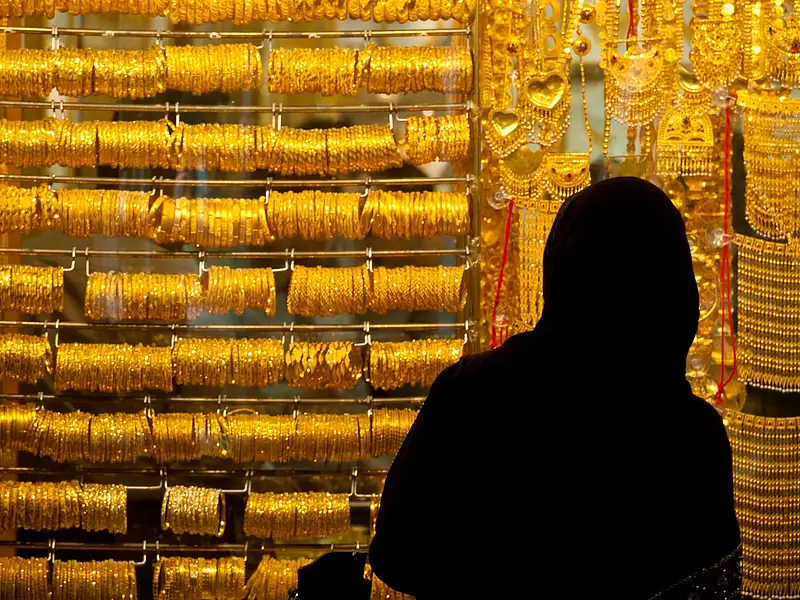
The gold price in Dubai moved slightly higher at the market open on Thursday as investors remained focused on upcoming US inflation data for clues about the Federal Reserve’s next interest-rate decision.
The latest US consumer and producer price figures are being closely watched by financial markets because they could influence expectations surrounding the Federal Reserve’s monetary-policy path. A stronger-than-expected inflation reading could reinforce expectations for higher interest rates and keep bond yields elevated, while softer inflation could ease some of the recent hawkish expectations.
At the Dubai market open on Thursday, September 10, the 24K gold rate stood at Dh531.25 per gram. The 22K variant was trading at Dh492 per gram, while 21K gold opened at Dh471.75 per gram. The 18K and 14K variants were priced at Dh404.25 and Dh315.50 per gram, respectively.
The movement in Dubai came as international gold prices edged lower during morning trading. Spot gold declined 0.13 per cent to $4,409.20 per ounce as of 9:05am UAE time. Silver also weakened, falling 0.81 per cent to trade at $67.52 per ounce.
Despite the slight decline in the international market, gold prices have remained relatively resilient as investors balance several opposing factors affecting the precious metal.
Ole Hansen, Head of Commodity Strategy at Saxo Bank, said gold traders were currently assessing several competing market themes, leaving prices largely rangebound around the $4,400-an-ounce level.
One of the main pressures on gold has been the changing outlook for US interest rates. Rising expectations of a US rate hike, combined with higher bond yields, have increased the opportunity cost of holding gold. Unlike interest-bearing assets such as government bonds, gold does not generate a regular yield, meaning higher yields can make the precious metal relatively less attractive to investors.
However, several factors have helped prevent a sharper decline in gold prices. A weaker US dollar, continued investment demand through exchange-traded funds and futures, and ongoing geopolitical uncertainty have provided support for the precious metal.
Hansen said gold traders, along with algorithmic trading programmes that account for a significant portion of day-to-day market activity, were struggling to determine which of several competing factors would ultimately drive prices.
According to Hansen, these conflicting themes have kept gold trading within a relatively narrow range around $4,400 an ounce.
The US dollar has also played an important role in the recent performance of gold. The Bloomberg Dollar Index has declined 1.25 per cent over the past month, with stronger Asian currencies contributing to the pressure on the greenback.
The Korean won, Japanese yen and Australian dollar have been among the currencies showing strength against the US dollar, according to Hansen.
A weaker dollar can provide support for gold because the precious metal is priced internationally in US dollars. When the dollar declines, gold can become relatively cheaper for holders of other currencies, potentially supporting demand.
For investors in Dubai, movements in international gold prices, the US dollar and broader financial markets can all influence local bullion rates. Dubai’s gold market closely tracks global bullion prices, while local retail prices can also vary depending on the purity of gold, making charges and individual jeweller pricing.
The next major focus for traders is US inflation.
Hansen said this week’s consumer and producer price data could play an important role in determining the direction of gold ahead of the Federal Reserve’s September meeting.
The consumer price data is particularly significant because inflation remains a key consideration for the Federal Reserve when determining the appropriate level of interest rates. A hotter-than-expected inflation report could strengthen expectations for tighter monetary policy, while weaker inflation could encourage markets to reassess those expectations.
“A hotter inflation print would likely reinforce rate-hike expectations and keep yields elevated, while softer data could quickly unwind some of the recent hawkish repricing,” Hansen said.
Higher yields are generally viewed as a headwind for gold because they increase the relative attractiveness of income-generating assets. If investors can earn higher returns from bonds and other interest-bearing instruments, the appeal of holding a non-yielding asset such as gold can diminish.
At the same time, gold continues to benefit from its traditional role as a safe-haven asset. Periods of geopolitical uncertainty can encourage investors to maintain or increase exposure to precious metals as a way of diversifying portfolios and managing risk.
Investment demand through exchange-traded funds and futures has also remained an important source of support for the market. Continued demand from these channels suggests that some investors remain constructive on gold despite pressure from interest rates and bond yields.
The combination of these factors has produced a market in which gold prices are being pulled in different directions.
On one side, higher yields and expectations surrounding US monetary policy are creating pressure. On the other, a weaker dollar, investment demand and geopolitical risks are providing support.
This tug-of-war has left international gold prices close to the $4,400-per-ounce level and has contributed to relatively limited price movement in recent sessions.
For Dubai consumers, the current market environment means gold prices could remain sensitive to developments in the US economy and Federal Reserve policy. Any significant change in expectations for interest rates could quickly influence international bullion prices and, in turn, local gold rates.
If US inflation comes in above expectations, traders could increase bets on tighter monetary policy. Such a development could lift US bond yields and provide additional support to the dollar, potentially weighing on gold.
Conversely, softer-than-expected inflation could reduce expectations for higher rates. Lower yields and renewed pressure on the US dollar could then provide a boost to gold prices.
The upcoming data therefore represents an important near-term catalyst for the precious metals market.
The gold price in Dubai is also likely to remain closely watched by consumers, jewellery buyers, traders and investors as the market responds to the latest economic indicators.
With 24K gold opening at Dh531.25 per gram on Thursday, prices remain at elevated levels despite the modest decline in international spot gold. The difference between movements in global bullion prices and local retail rates can also reflect market conditions, currency movements and charges applied by individual retailers.
As traders await the latest US inflation figures, the precious metals market is expected to remain sensitive to every indication about the Federal Reserve’s future policy direction.
For now, gold remains caught between competing forces. Higher yields and rate expectations are limiting gains, while a weaker dollar, investment demand and geopolitical uncertainty are helping to cushion the downside.
The market’s next major move could depend on whether incoming US inflation data strengthens or weakens expectations for the Federal Reserve’s September policy decision.
Until then, the gold price in Dubai is likely to remain closely tied to developments in global financial markets, with investors continuing to watch the US dollar, Treasury yields and inflation data for the next clear direction.
Post Views: 28