Dubai is preparing to take its infrastructure model beyond the emirate as Dubai Electricity and Water Authority (DEWA) moves into a new phase of international expansion.
The strategy comes after more than three decades of investment in electricity, water, renewable energy, digital technology and infrastructure. DEWA is now seeking to apply the experience developed in Dubai to international energy and water projects through its newly established subsidiary, DEWA International.
The development comes alongside strong financial and operational results from major Gulf institutions. Saudi Arabia’s Public Investment Fund (PIF) reported higher revenue and more than doubled its net profit in 2025, while Abu Dhabi-listed AD Ports Group recorded an 88 per cent rise in second-quarter net profit despite disruption linked to the Strait of Hormuz.
Al Shera’a showcases Dubai’s infrastructure ambitions
On May 15, H.H. Sheikh Mohammed bin Rashid Al Maktoum, Vice-President and Prime Minister of the UAE and Ruler of Dubai, inaugurated Al Shera’a, DEWA’s new headquarters in Dubai’s Al Jaddaf district.
Designed in the shape of a sail and rising 19 storeys above Dubai Creek, Al Shera’a is described as the world’s tallest, largest and smartest net-positive government building.
Over the course of a year, the building is designed to generate more clean energy than it consumes.
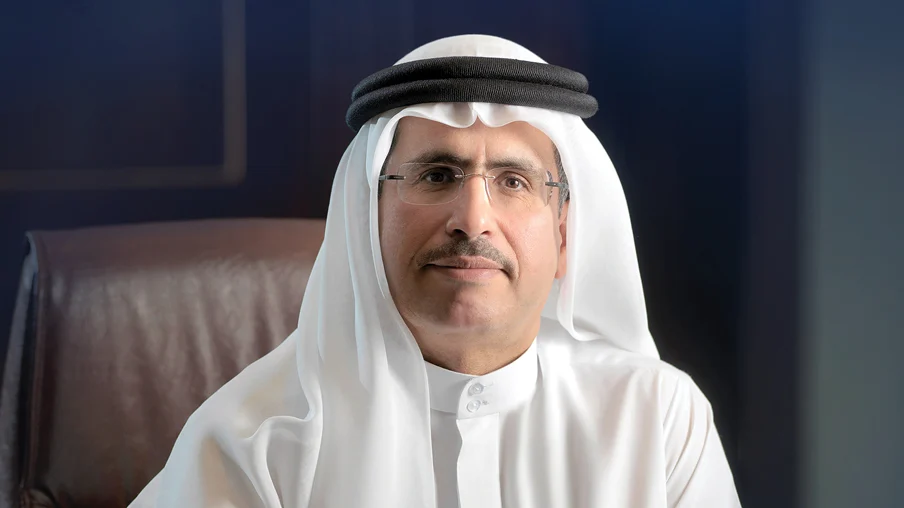
H.E. Saeed Mohammed Al Tayer, Managing Director and CEO of DEWA, briefed Sheikh Mohammed on the building’s advanced cognitive system, which integrates Internet of Things technology, big-data analytics and artificial intelligence.
The headquarters contains more than 110,000 smart sensors, over 1,500 wireless access points and more than 3,200 network devices.
Together, these systems monitor environmental and operational conditions in real time and generate more than 1.9 million automated control commands every day.
The building has therefore become a physical representation of DEWA’s wider approach to infrastructure: ambitious, technology-driven and focused on measurable results.
Three decades of DEWA leadership
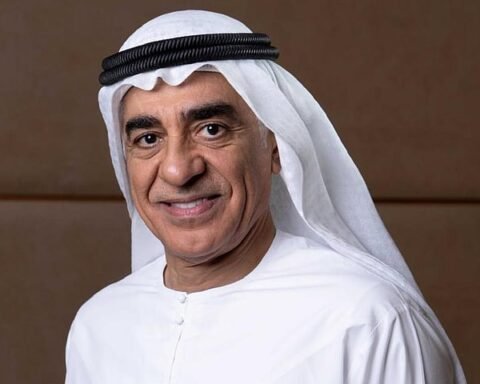
Al Tayer has led DEWA since its establishment in 1992.
During his tenure, the utility has developed into one of the world’s most closely benchmarked energy and water providers. DEWA ranks first globally across 13 key performance indicators and two regional benchmarks covering generation, transmission, distribution and customer service.
Al Tayer also holds several senior positions across Dubai’s infrastructure and economic institutions. He serves on the Dubai Executive Council, the Dubai Supreme Fiscal Committee and the Dubai Council.
He is vice chairman of the Dubai Supreme Council of Energy and chairs or holds leadership positions at companies including ENOC, Dragon Oil, Emirates Global Aluminium and EMPOWER.
In 2025, Al Tayer became the first civilian recipient of the Life of Leadership Excellence Award from Britain’s Royal Military Academy Sandhurst.
His approach has centred on execution, financial discipline and continuous improvement.
That strategy has been reflected in DEWA’s recent financial performance.
Record financial performance
DEWA delivered its strongest-ever first-quarter performance in Q1 2026.
Revenue reached $1.76 billion, while operating profit increased 53.6 per cent year on year. Profit after tax rose 89.9 per cent.
Cumulative investment in Dubai’s energy and water infrastructure has now exceeded $74 billion, while the number of customer accounts has increased to approximately 1.35 million.
DEWA has also developed a financial structure more closely resembling a major listed infrastructure company than a traditional state utility.
The authority has been listed on the Dubai Financial Market since April 2022.
For 2025, DEWA reported record revenue of $8.94 billion, EBITDA of $4.72 billion and profit after tax of $2.47 billion.
Electricity generation reached 62.21 TWh, including 10.10 TWh of clean power generation.
Peak electricity demand reached 11.39 GW, while desalinated water production totalled 161.5 billion imperial gallons.
Installed power-generation capacity reached approximately 18 GW and installed desalination capacity reached 555 million imperial gallons per day.
For Al Tayer, financial strength provides DEWA with what he describes as “strategic freedom” — the ability to continue investing in large-scale infrastructure while maintaining financial strength and delivering returns to shareholders.
Solar power drives the clean-energy transition
Renewable energy has been central to DEWA’s long-term strategy, particularly through the Mohammed bin Rashid Al Maktoum Solar Park.
The solar park is described as the world’s largest single-site solar park and holds multiple Guinness World Records.
DEWA developed the project through the independent power producer model, attracting international developers and investors while helping establish highly competitive solar tariffs.
The planned capacity of the solar park for 2030 has now been increased to 8,060 MW, compared with the original target of 5,000 MW.
The expansion is expected to raise Dubai’s clean-energy contribution to 36 per cent, compared with the initial target of 25 per cent.
Annual carbon-emissions reductions are expected to exceed 8.5 million tonnes, above the original target of 6.5 million tonnes.
In 2025, DEWA completed 1,000 MW of the solar park’s 1,800 MW sixth phase.
The project also includes a 263-metre concentrated solar power tower, described as the world’s tallest, alongside thermal-energy storage capacity of 5,907 MWh.
DEWA is also investing in other clean-energy technologies.
The Hatta Pumped-storage Hydroelectric Power Plant, the first of its kind in the GCC, will provide 250 MW of generation capacity and 1,500 MWh of energy storage.
In water production, DEWA is increasing its use of reverse-osmosis desalination technology and reducing dependence on traditional thermal processes.
By 2030, the authority plans for 100 per cent of its desalinated water production to use waste heat and clean energy.
Technology and reliability
DEWA’s infrastructure strategy extends beyond generation capacity and physical networks.
Reliability has become one of its most important performance measures.
Customer minutes lost from electricity interruptions have fallen to 0.82 minutes per customer annually, equivalent to approximately 49 seconds.
Electricity network losses stand at 2 per cent, while water-network losses have declined to 4.4 per cent.
Dubai’s electricity system reliability exceeds 99.99 per cent.
Artificial intelligence and digital systems increasingly support these results.
DEWA’s Automatic Smart Grid Restoration System can identify faults, isolate affected sections and automatically restore electricity supply.
Its intelligent gas-turbine controller at Jebel Ali Power Station operates autonomously.
Rammas, DEWA’s AI-powered virtual employee, has handled more than 13 million customer queries since its launch in 2017.
The authority is supporting its digital transformation through its Dhs7 billion Smart Grid Strategy, which runs until 2035 and includes 19 enablers designed to improve efficiency, reduce losses and support renewable-energy integration.
Strengthening the infrastructure value chain
DEWA has also expanded its presence across the wider infrastructure ecosystem.
One of its major moves has been increasing its stake in Emirates Central Cooling Systems Corporation, known as EMPOWER.
DEWA increased its ownership from 56 per cent to 80 per cent in a transaction valued at $1.41 billion.
EMPOWER is the world’s largest district-cooling provider by connected capacity.
The transaction reflects DEWA’s broader strategy of securing greater control over infrastructure assets that are strategically important to Dubai’s future energy and sustainability needs.
DEWA now oversees a portfolio of more than 10 successful operating companies and operates across several parts of the infrastructure value chain as a planner, developer, financier, offtaker and shareholder.
DEWA International begins a new chapter
The most significant development in DEWA’s expansion strategy came in June with the launch of DEWA International.
H.H. Sheikh Ahmed bin Saeed Al Maktoum, Chairman of the Dubai Supreme Council of Energy, launched the wholly owned independent subsidiary, which will develop conventional and clean-energy and water projects internationally.
The move represents a significant change in DEWA’s role.
Rather than focusing exclusively on Dubai, the authority is now positioning itself as an international infrastructure developer and partner.
Al Tayer has stressed that the objective is not simply to export individual projects.
Instead, DEWA International aims to export the systems, expertise and operating model developed in Dubai.
This includes project structuring, governance, risk allocation, digital transformation, operations and maintenance, as well as the ability to attract international investment through bankable infrastructure models.
DEWA’s experience with independent power producer and independent water producer structures will be particularly important.
The company will pursue co-development and co-investment opportunities with governments, developers and financial institutions.
The initial focus will be on markets where Dubai’s relationships, experience and geographical position provide a natural advantage.
Post Views: 31